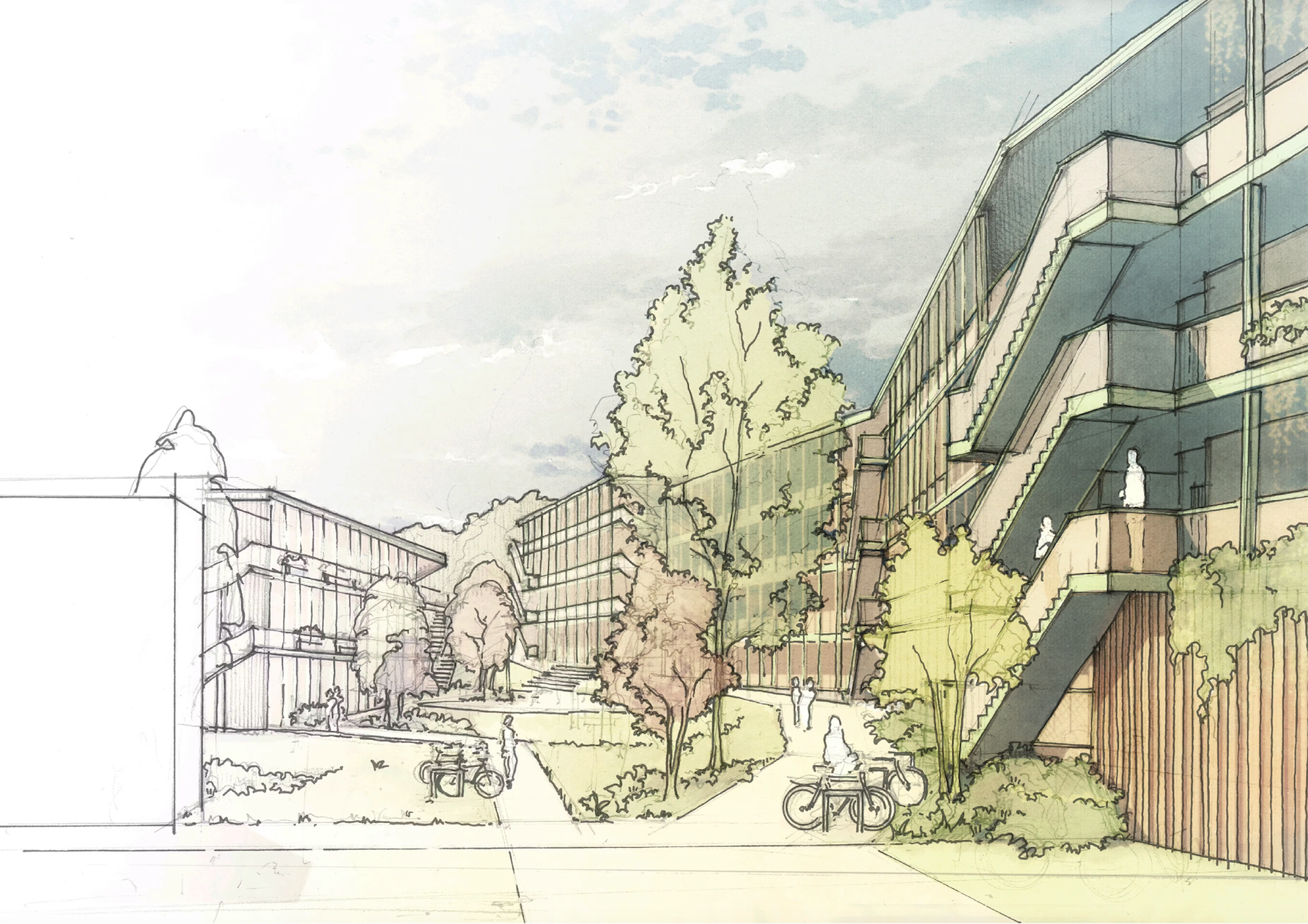
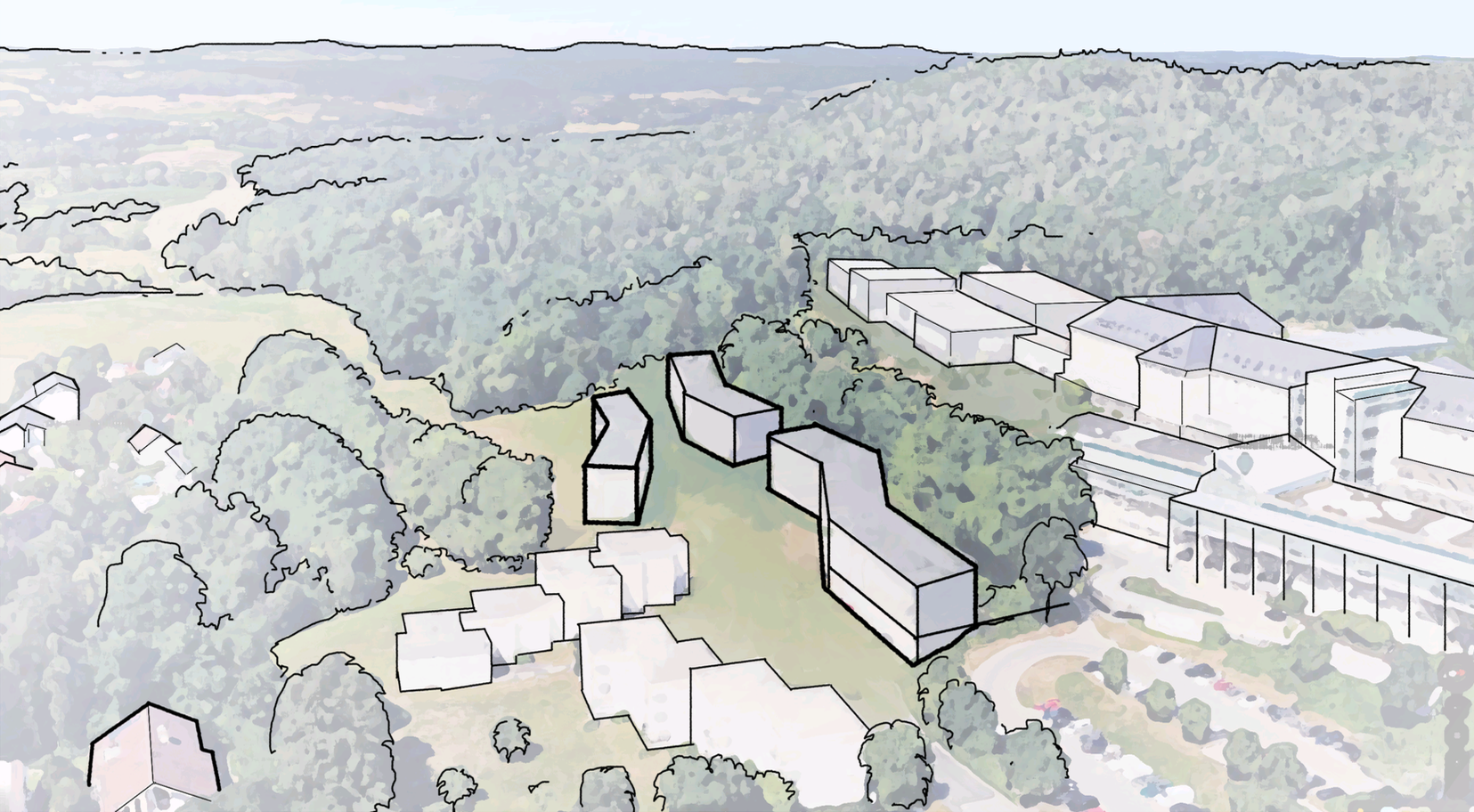
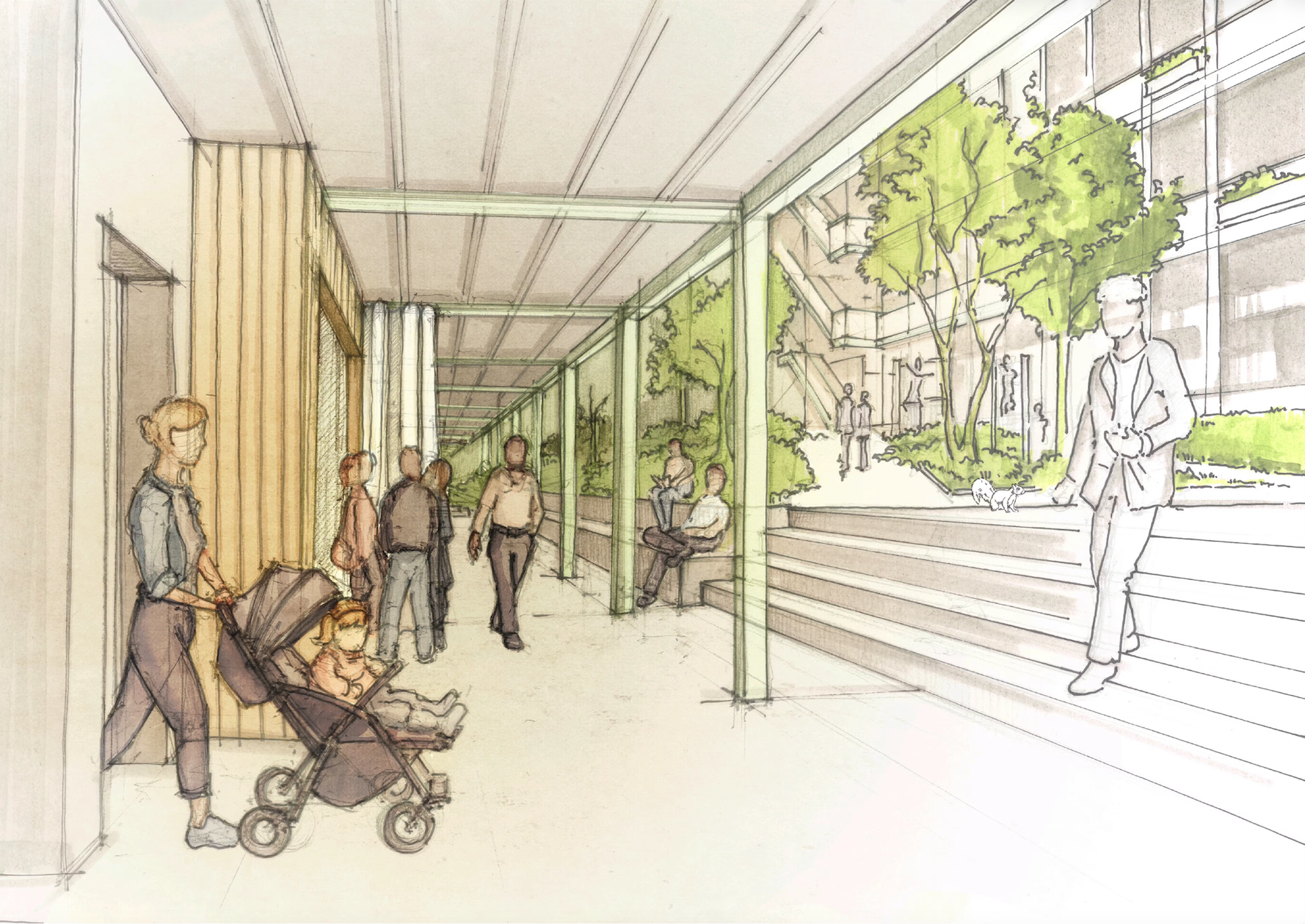
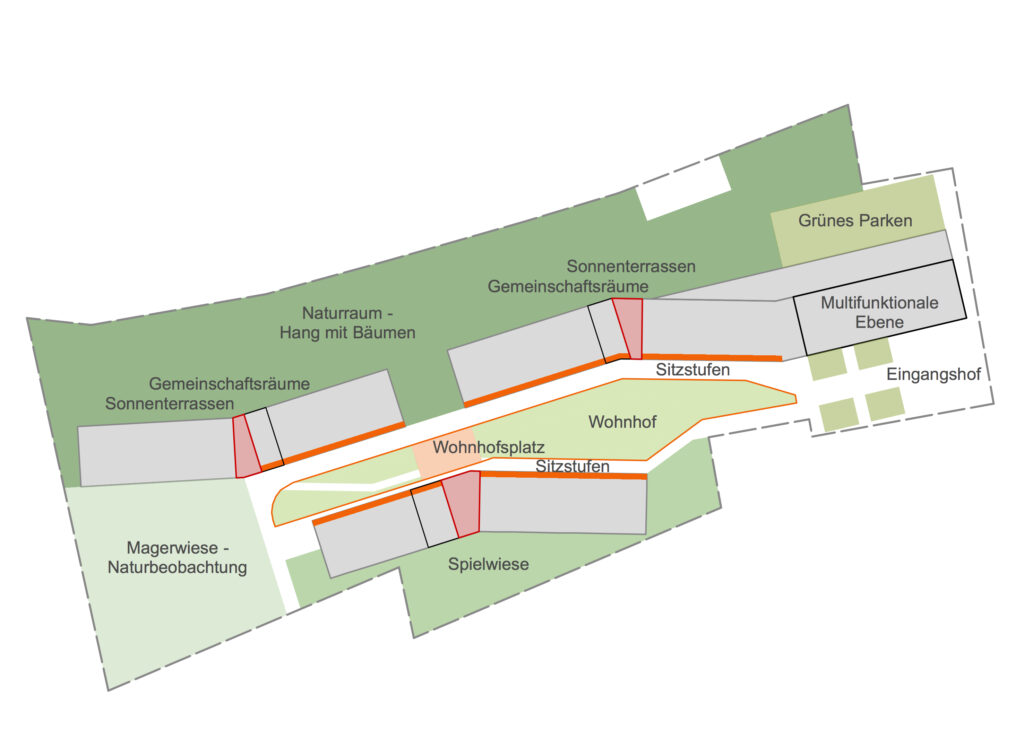
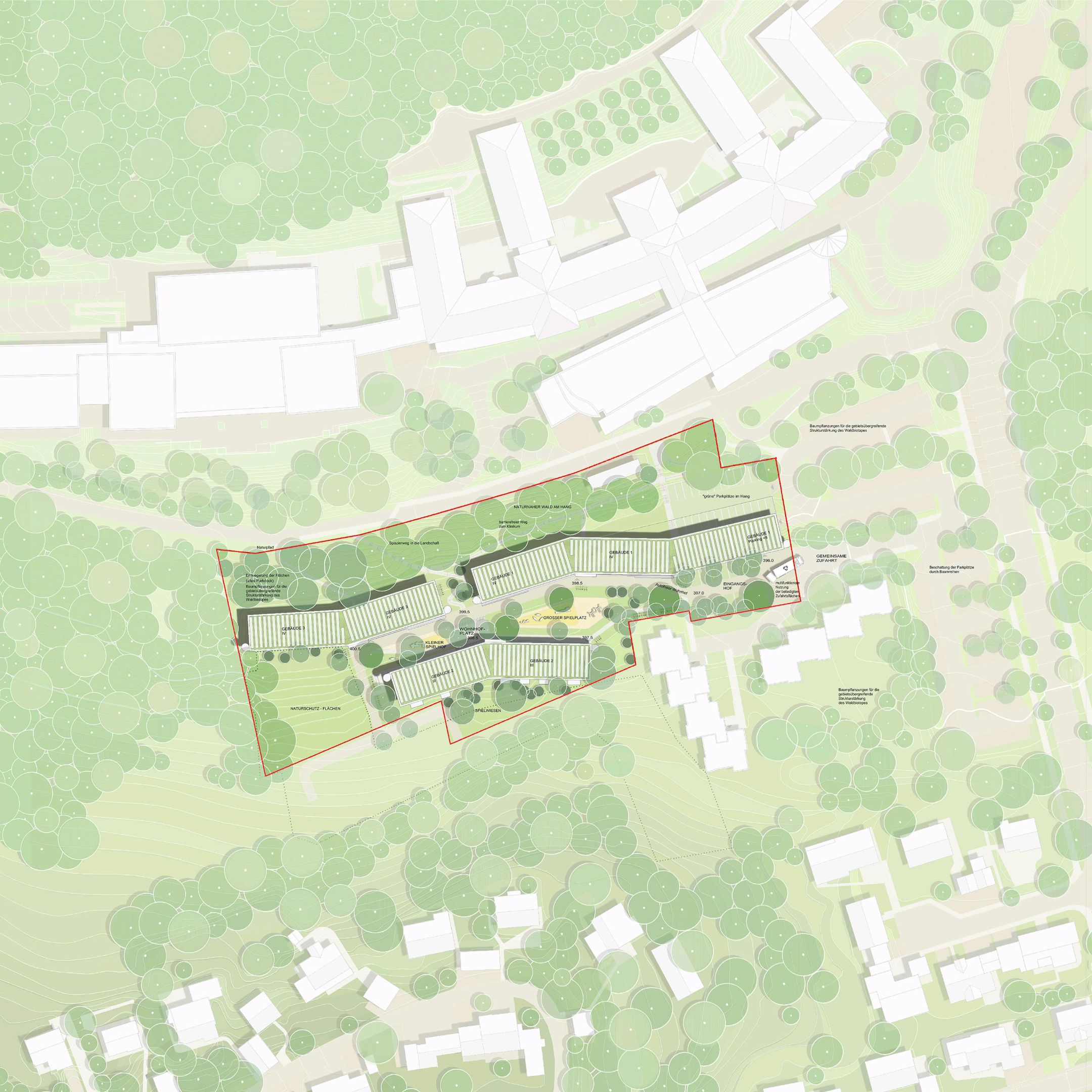
The new neighbourhood for employees of the Hohe Warte Clinic is characterised by its topographical location on a slope. This is reflected in the design of the buildings and open spaces, with the buildings, some of which are connected by pergolas, staggered in height to suit the terrain and creating space in the middle for a gently sloping central green. The pergolas face this green centre of the quarter, which serves as a communal communication and open space.
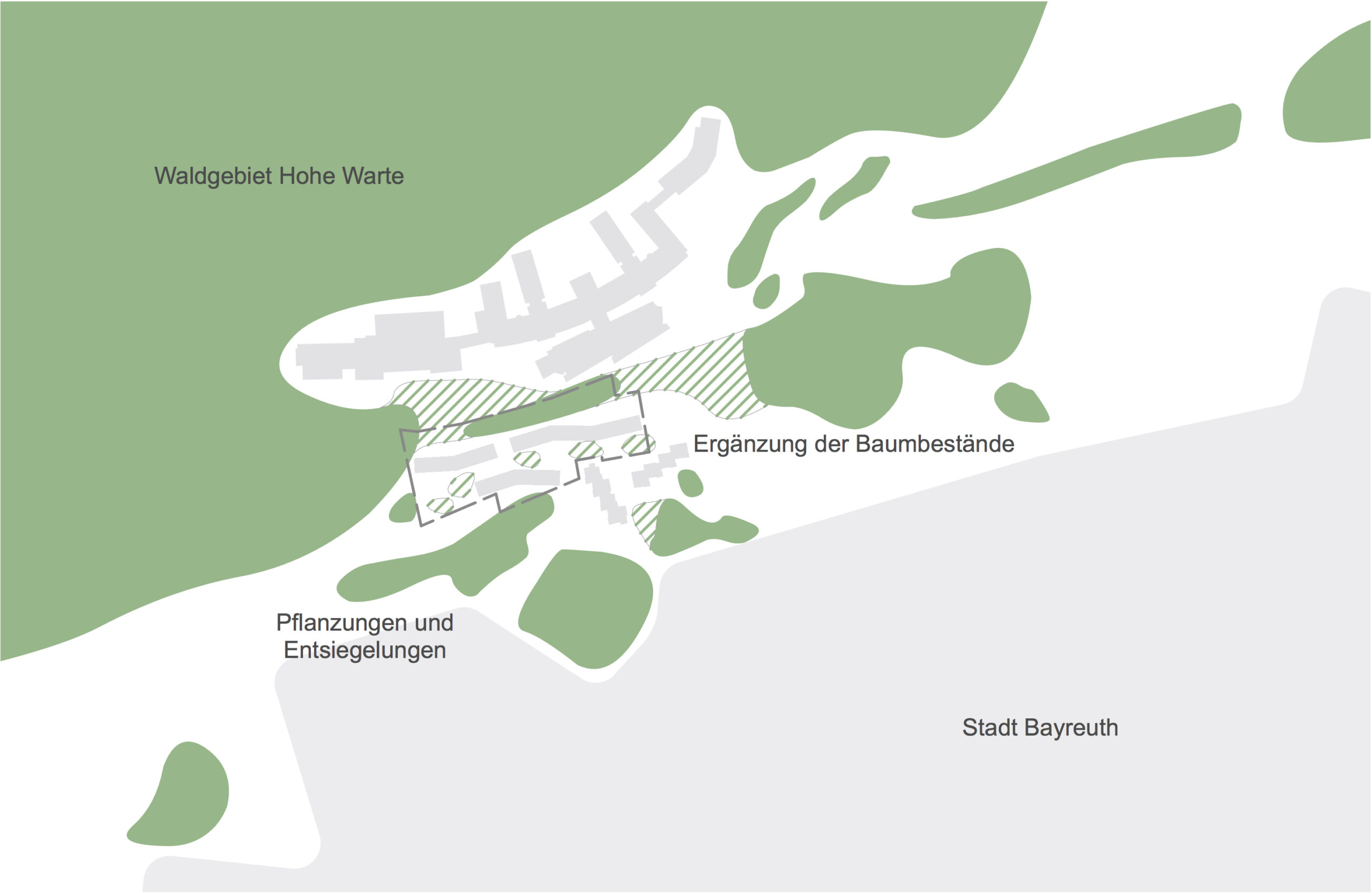
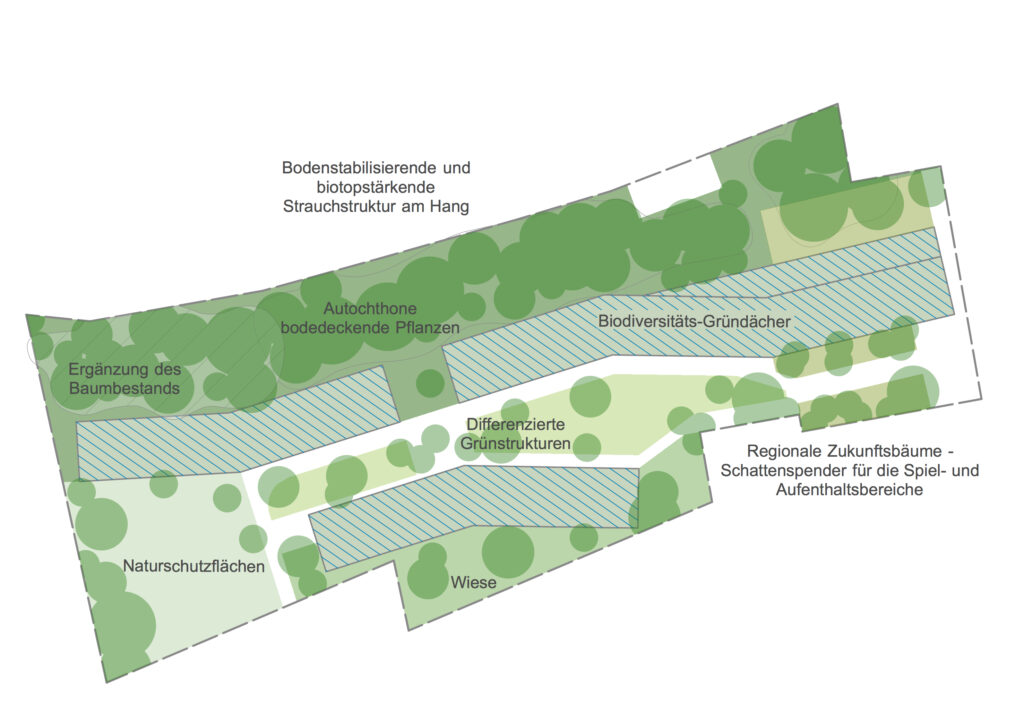
At the western end of the quarter, there are also nature conservation areas that are being preserved and expanded.
The development of the biotope network in the north of the city of Bayreuth is taking place through additional tree planting in the area around the hospital. The removal of impervious surfaces and the upgrading of paved areas with water-permeable surfacing, as well as the expansion of the tree population in the competition area, are promoting the development of the green belt.
HEIGHT GRADATION OF THE BUILDINGS
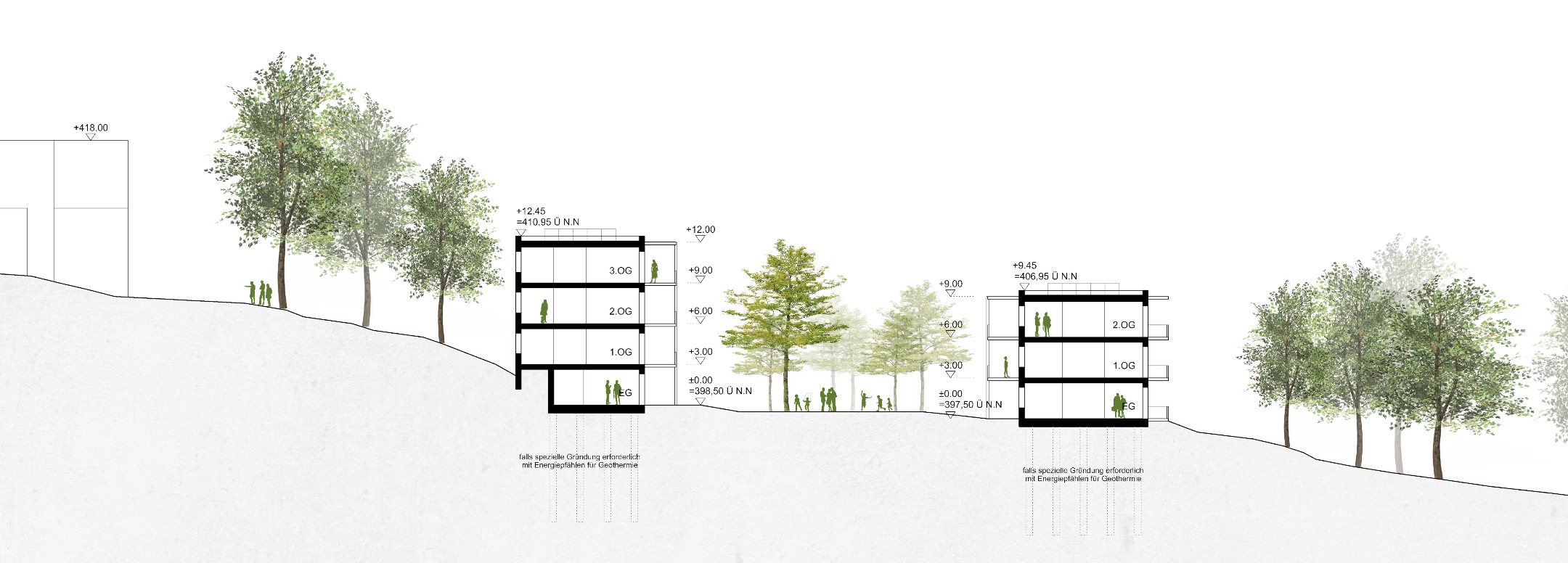
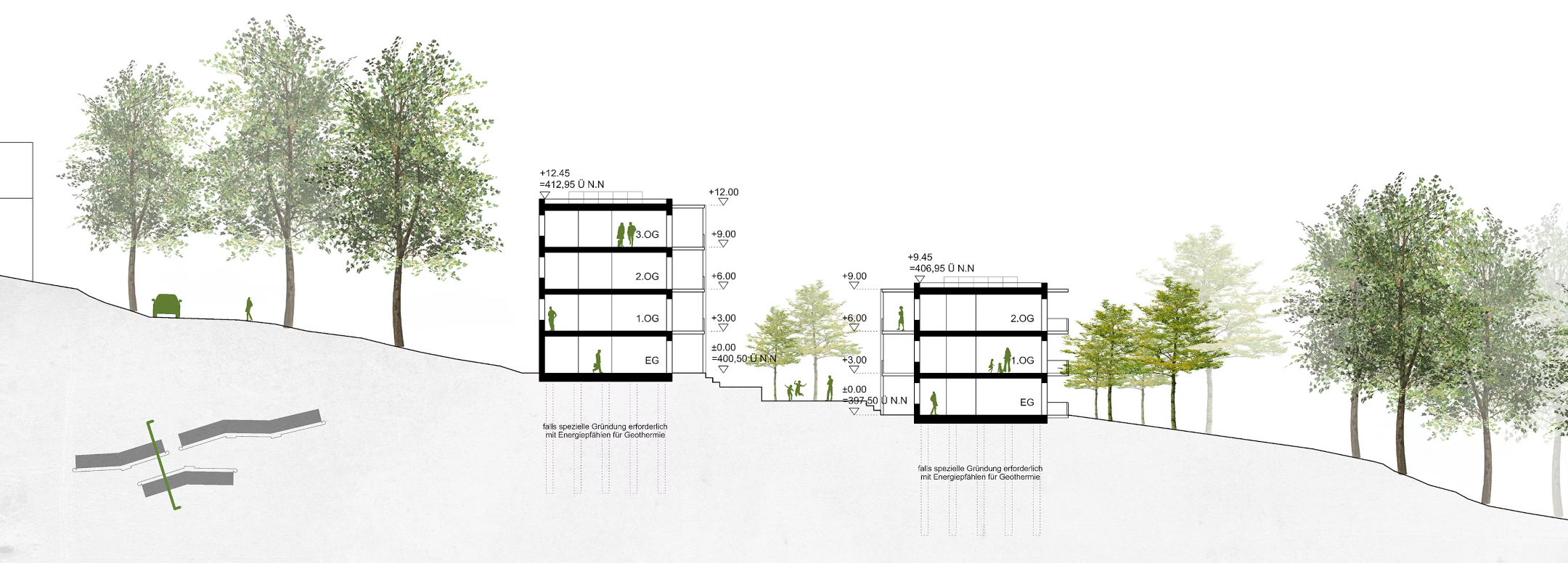
The buildings are staggered along the natural terrain in an east-west and north-south direction, with a gradation from four to three storeys ensuring optimal contemplation.
The dynamics of the topography and the landscape are transferred to the building forms, and the height levels are reflected in the linearity of the horizontal pergola structure.
TOPOGRAPHY
The terrain of the neighbourhood runs evenly in an east-west direction with an approx. 3% gradient for accessibility. The building development along the contour lines creates space and conserves resources.
THE OPEN SPACES
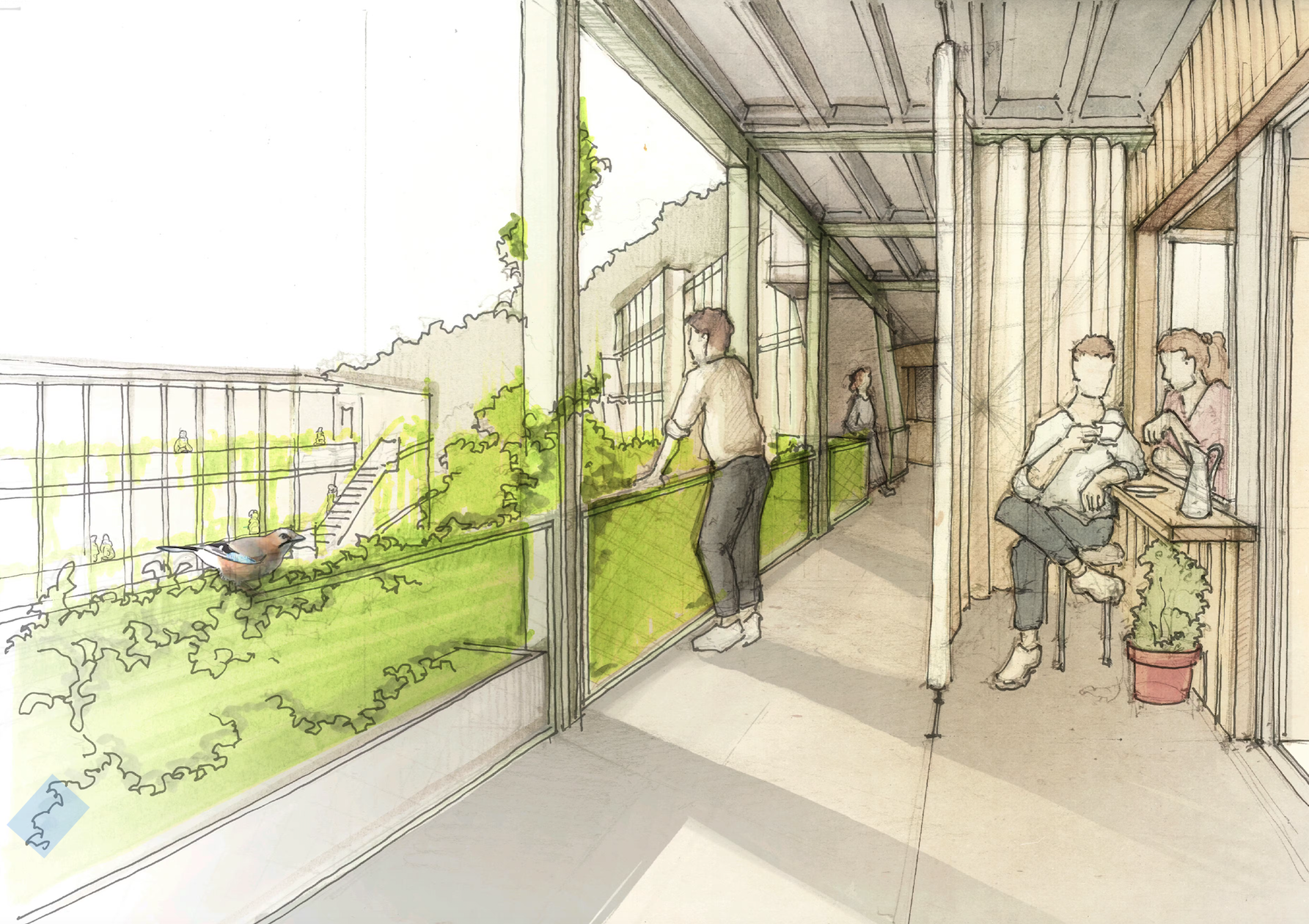
A variety of open spaces extend between the buildings: a shared entrance with the neighbourhood, a green entrance courtyard, play areas for young and old, a residential courtyard and protected vegetation areas. Sun terraces and seating steps along the pergolas offer space for meeting and socialising.
The apartments have views of the surrounding landscape and the hospital (principle of open-plan living). In addition, the individual apartments are closely connected via the communal pergolas.
NATURE CONSERVATION AND VEGETATION
The preservation of nature conservation areas and the development of vegetation are the basis for nature-sensitive planning. The prerequisite for sustainable and stable vegetation is climate-appropriate species adaptation and the use of plants suitable for the location.
ACCESS AND COMMUNICATION
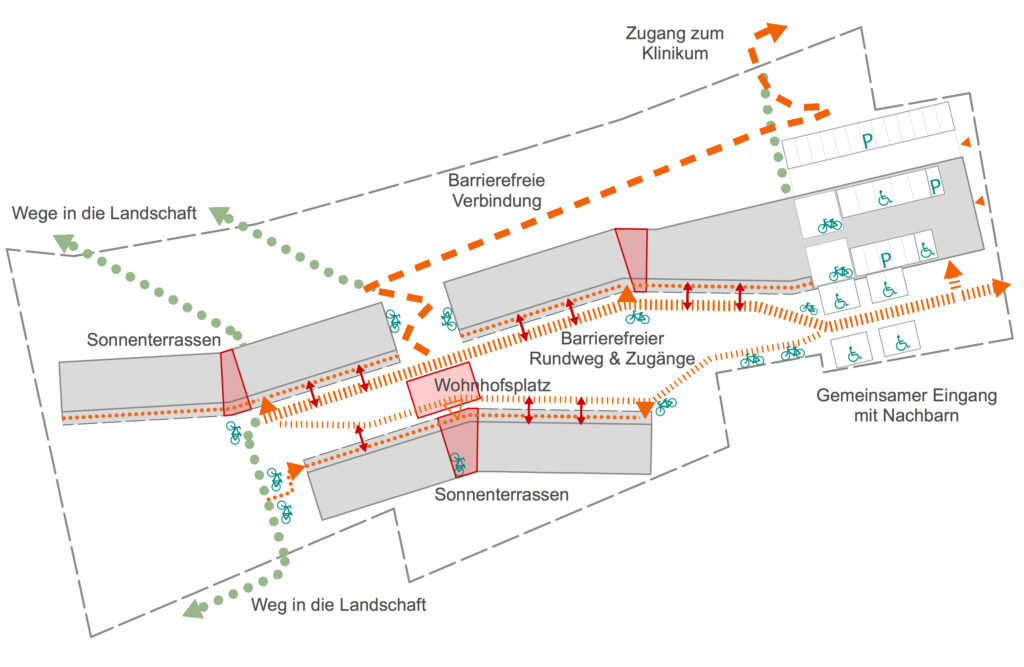
Communal areas such as the courtyard and sun terraces are accessible from the clinic and connected by a central circular path. Bicycle and disabled parking spaces with charging stations are located at the entrance to the neighbourhood. Despite differences in ground level, the pergola provides a quick connection between the residential area and the outdoor space.
RAINWATER MANAGEMENT
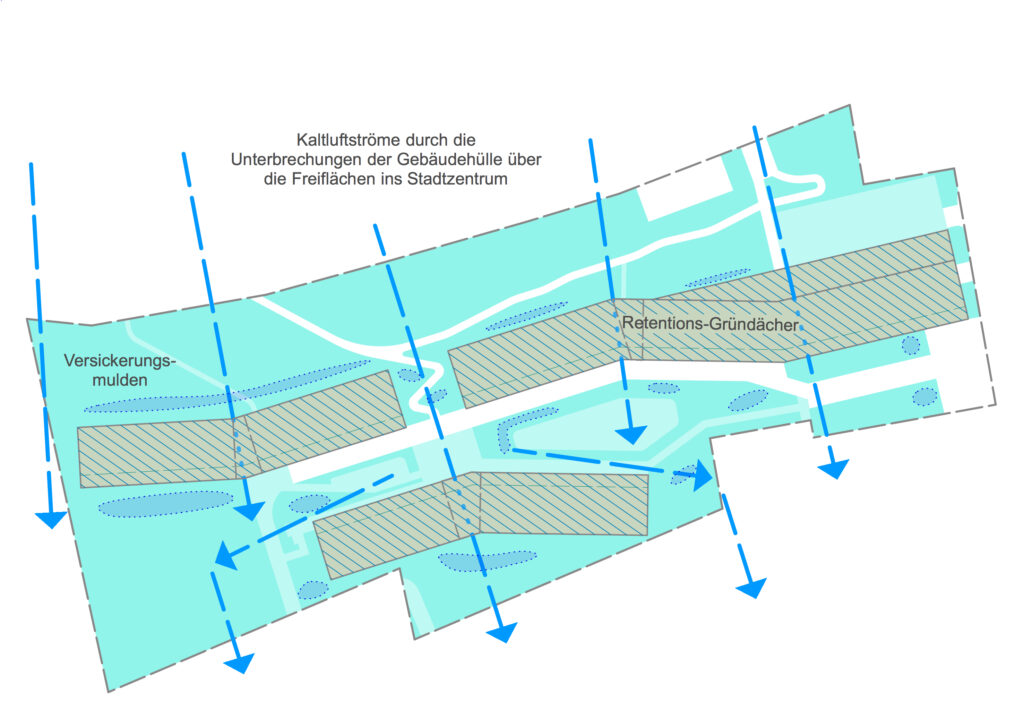
Rainwater is temporarily stored where it falls. A large part of it can evaporate via ‘green/blue’ elements such as troughs, tree trenches, green roofs and facades and seep away on site, which greatly reduces runoff. The respective elements are used complementarily in suitable locations.